


Playard Buying Guide: How to Pick a Safe Indoor Play Space for Your Baby

A playard is a foldable, mesh-sided baby space that gives your baby a safe spot to play, nap, and hang out while you get things done around the house. The right one has a sturdy frame, breathable mesh, a firm base, and fits the layout of your home without eating up half the living room.
Most parents end up buying one somewhere between the second trimester and the baby's fourth or fifth month, once the novelty of newborn cuddles gives way to the reality of needing both hands free for a few minutes at a stretch.
This playard buying guide for babies covers what a playard actually is, how it is different from a cot or playpen, the safety features worth checking, the right age to use one, price brackets in India, and the common mistakes worth skipping.
It is not just about every parent’s dream product filler, but rather about focusing on what is actually important before you invest. This guide is designed to help all Indian homes, joint families, flats, and others.
What a Playard Actually Is?
Oftentimes, parents tend to confuse the playcard with a cot, crib, or playpen. The confusion here is quite fair because in the Indian market, these terms are often used loosely.
You need to get the names right before you buy, as it will help you compare products properly instead of just guessing.
What is the simple meaning of playard?
The playard is a portable and foldable baby space with mesh sides and a padded, firm base. There are some models that allow a baby to nap inside, and others are specifically designed for daytime play only.
In terms of application, you’d find somewhere in between a full crib and a basic playpen, giving you a bit of both.
Playard vs cot vs playpen vs crib
Here is the playard vs cot vs playpen difference laid out simply, since this is where most first-time parents get stuck.
|
Product |
Main Use |
Age Range |
Portable or Fixed |
|
Playard |
Play plus supervised naps |
Newborn to 18-24 months |
Portable, folds down |
|
Cot |
Overnight sleep |
Newborn to 2-3 years |
Mostly fixed |
|
Playpen |
Play only, no sleep |
6 months to 2 years |
Semi-portable |
|
Crib |
Overnight sleep, smaller footprint |
Newborn to 6-9 months |
Mostly fixed |
-
Why do the names get mixed up in India?
Indian brands and Instagram sellers use "playard," "playpen," and even "crib" almost interchangeably in captions and listings, which does not help anyone trying to compare products across two or three websites.
Playard is really short for "play yard," and in practice, most playards sold here double up as a nap space too, which adds to the mix-up further since the same product photo can show up tagged under three different names.
Why are Indian Parents Buying Playards More?
Playards have become a lot more common in Indian homes over the past few years. Small flats, both parents working, and joint family setups are all pushing this shift, and picking the best playard for Indian babies now means thinking about space constraints as much as safety.
-
It is a safe spot in a small flat:
A 1 BHK or 2 BHK rarely has room for a full nursery corner. A playard gives the baby their own dedicated zone that folds away completely when it is not needed, which matters a lot in a foldable playard for small apartment in India setup where every square foot counts.
-
Hands-free cooking and cleaning time:
As a mother, you can chop vegetables with the baby in sight but safely out of reach of the gas stove. The same goes for other activities such as laundry, sweeping, and the many other small jobs that pile up throughout the day, especially in homes without full-time domestic help.
-
Ready zone for grandparents to watch the baby:
The grandparents of the family can sit comfortably near the playard while the baby plays inside it. They don’t need to bend down to floor level all the time or chase a crawling baby across the room. This will give less strain on older knees and more peace of mind for the whole family.
-
It works as a travel cot too:
The Playard fits into a car boot, works fine at a hotel, at nani's house, or on a weekend trip. It is genuinely one product doing the job of several, which is part of why it has become popular so quickly.
The Right Age to Use a Playard
To begin with, the playard is not to be used at every stage of a baby’s growing-up years. There is a sweet spot for you to know to save money or spend on something that your baby will outgrow within a few months.
This also comes up as the most common regret when they buy based on the sale price alone rather than for the age window they actually require.
-
From newborn to 6 months:
Some playards come with a raised bassinet insert, which works well for the first five to six months. The baby sleeps or naps here while the mother rests nearby, without needing a separate crib in the room.
-
6 to 12 months is the golden window:
This is genuinely the best age to use baby playard, since the baby is now sitting, rolling, and starting to crawl. It becomes a proper safe zone for play while a parent cooks, cleans, or takes a work call from home.
-
12 to 24 months and beyond:
Some toddlers stay happily occupied in a playard till around 18 months. Once they start climbing out, usually somewhere between 15 and 20 months, it is a clear sign that it is time to shift toward full baby-proofing instead.
-
When to stop using it fully:
Knowing when should baby stop using playard comes down to three clear signs: the baby crossing the usual weight limit of around 15 kg, climbing over the side panels, or simply refusing to stay inside anymore. Any one of these three means it is time to move on.
Safety Features to Check Before You Buy
You need to ensure the safety parameters of the playard. After all, the purpose of this product is largely safety, so you need to evaluate the product based on its safety features, along with how convenient it is for the baby.
Knowing how to choose a safe baby playard really comes down to checking these points one by one, rather than trusting packaging claims or a glossy product photo.
-
You need a sturdy frame that locks in place:
You need to shake the frame in the store if you can, or make sure you read all the reviews carefully if buying online. It needs to feel solid, never wobbly, and the locking joints must click firmly into place with no give when pressed.
-
Breathable mesh sides on all 4 panels:
Mesh lets air flow through so the baby stays cool, especially through the warmer months, lets you see the baby from any angle in the room, and stops the baby from climbing since small fingers do not grip mesh easily.
Tightly woven mesh, without any loose or stretched sections, is what to look for, and it is worth running a hand along the panel in the store to feel for any give.
-
Firm flat base with no extra padding:
The base needs to stay firm and completely flat. Soft, cushiony bases are a genuine suffocation risk for babies under 12 months, and the mattress that comes packaged with the playard is the only one that should ever go inside it, no matter how thin or unforgiving it looks compared to a regular cot mattress.
-
Locked wheels for stability:
If the playard comes with wheels, they must lock tightly in place. Unlocked wheels can slide across tile or marble floors the moment a baby leans against the side panel.
-
BIS or international certifications:
You should look for a BIS mark where applicable. There are also international benchmarks like EN 12227 for playpens or the relevant ASTM standard for the juvenile products category.
-
- When you buy a certified product, it means it has been tested for pinch points, fall risk, and overall material safety. This is way more worth than any marketing claim on the box.
-
BPA-free and non-toxic materials:
Make sure you check for BPA-free plastic and lead-free paint or coating labels on the frame and mesh trims. This is simply because the babies tend to chew on everything within reach, so what the playard is actually made of matters just as much as how it looks.
-
Quick Checklist Before You Buy Playard
This is a fast way to run through the playard safety checklist for parents before any purchase, online or in-store, and doubles as a quick refresher on how to choose a safe baby playard if you are comparing more than one model side by side.
|
Feature |
What to Check |
|
Frame |
Locks firmly, no wobble when shaken |
|
Mesh |
Tightly woven, no loose or torn sections |
|
Base |
Firm and flat, original mattress only |
|
Wheels |
Lock securely if present |
|
Certification |
BIS mark or EN/ASTM equivalent |
|
Material |
BPA-free plastic, lead-free paint |
|
Sharp edges |
None on frame joints or zippers |
|
Weight limit |
Clearly listed in the manual |
Features That Make Daily Life Easier
Safety is non-negotiable. These extras are simply nice to have, and which ones matter to you depends entirely on how you plan to use the playard day to day.
-
One-hand fold and set up:
You will often have the baby balanced in one arm while trying to set things up. A playard that folds and opens using a single hand is a genuine win, and it should ideally take under thirty seconds either way.
-
Removable bassinet for newborn use:
You get a raised insert that turns a regular playard into a bassinet. For the first six months, this saves your back from constant bending and gives the newborn a dedicated nap zone from day one.
-
Side zip for older baby play:
Some playards include a side-zip door so that the baby can crawl in and out independently. This becomes genuinely useful around 12 to 18 months, as toddlers start walking and want to come and go on their own.
-
Storage pockets and basket below:
When you use the side pockets for toys, wipes, and diapers, it can help to keep the essentials within arm's length for quick grab.
Also, there are some models that install a mesh basket underneath for extra storage. This is definitely a nice-to-have, but never a deal-breaker on its own.
-
Wipeable fabric for easy cleaning:
This is so much more important, especially for Indian households, than you’d expect. The food stains, spit-up, and diaper leaks happen all the time. You need wipeable fabric surfaces for easy cleaning that can save you so much time.
4 Playard Types Available in India
There are four primary styles that are commonly sold in Indian shops. Each one of these will suit a slightly different need.
You need to know about these use cases beforehand, as it is an essential part of any sensible playard buying guide for babies. After all, choosing the wrong type is one of the most common regrets parents mention after a few months of use.
-
Basic playard for play only
The simple mesh sides with a padded floor, built only for play and not for sleep. It is best suited to babies six months and older who mainly need a safe daytime zone.
-
2 in 1 with bassinet insert
This comes with both a raised newborn bassinet and the standard play space in one unit. Ideal for parents wanting a single product that works from the newborn stage right through to around 18 months.
-
Multi-function nursery center
It combines a bassinet, a changing table, a play zone, and storage in one structure. This is the most feature-loaded option, and it works particularly well in very small flats where everything needs to live in one spot.
-
Travel playard for trips
Ultra-light, usually under 6 kg, and folds into its own carry bag for easy packing into a car boot. Well suited to families who travel often or split time between their own home and the grandparents' place.
Price Brackets for Indian Parents
If you look at the price brackets for Playards in India, they are quite wide. It becomes essential for you to know what to expect at each level. By doing so, you won’t overpay for irrelevant features and focus on the safety basics that actually help.
-
Budget range under 3000 rupees:
At this budget range, you are just getting a basic-quality mesh playard. Here, there is just a simple fold with no bassinet insert. This can work only if you have a small daytime play zone where the safety and BICS certification are still non-negotiable.
-
Mid-range 3000 to 6000 rupees:
When you’re at this budget range, you can expect a 2-in-1 with a bassinet, wipeable fabric, locked wheels, and a noticeably sturdier build overall. Most Indian parents compare the best playard for Indian babies on a reasonable budget, this arrives at a sweet spot.
-
Premium range above 6000 rupees:
This is the premium pricing range where you will get a full nursery center, one-hand fold, a changing station, side-zip access, premium mesh, and usually a longer warranty. This could be worth the price if you want one product to genuinely last from birth right through to 18 months.
How to Set Up a Playard the Right Way at Home?
Where you place the playard matters almost as much as which one you buy. A few smart placement choices save you daily hassle later.
-
Choose a spot away from danger zones:
Keep the playard at least one meter away from windows, since curtain cords are a fall and strangulation risk, and also away from plug points, the gas stove, and any heavy furniture that could tip over onto it.
-
Make sure to level the floor:
Playards need genuinely flat ground underneath. Sloped floors, uneven tiles, or a rug bunched up under one leg of the frame can cause it to tip unexpectedly, so it is worth checking the base level after every setup.
-
Good ventilation and light:
You should opt for a place with natural airflow and daylight during the day, and not go for a closed-off dark corner. Make sure you redirect the AC vent that is blowing directly onto the playard to some other place.
-
Keep it away from older siblings' traffic:
You should keep it away from older siblings as they can easily run past it, knocking into the playard. The best is to put the playard in a corner spot, positioned against the wall.
5 Common Playard Mistakes to Skip
Even a genuinely good playard causes problems when it gets used the wrong way. These are the playard mistakes new parents make most often, and all of them are easy to avoid once you know about them, even if the packaging or the salesperson never mentions them upfront.
- You are adding extra padding or blankets inside: Parents often feel bad about the "hard" base and add a pillow, a quilt, or a thick blanket to soften it. All three are real suffocation risks for a young baby, so it is best to stick strictly to the mattress that came with the playard.
-
You’re leaving the baby in for long hours: The playard is a helper, not a babysitter. Around 30 to 45 minutes at a stretch works well for younger babies, and up to 60 minutes for older ones who are occupied with toys.
-
You’re using it as a punishment spot: Never turn it into a "go sit in the playard" punishment corner. The baby starts associating the space with being in trouble, and it quickly stops working even for the good, playful times.
-
You’re skipping the weight and height limits: Make sure to always check the manual for the maximum weight, which is usually around 15 kg, and the maximum height, around 90 cm. If you go past either limit, it will work against the entire safety design of the product.
-
You are buying a second-hand playard without a proper check: When you’re buying a second-hand playard, make sure to check for worn-out, overused mesh, missing parts or weakened locking joints, as they are not obviously visible right away.
You should thoroughly examine it, including all the joints, mesh panels, and locks, before you use it for the baby.
Playard vs Full Baby Proofing: Which One Do You Need?
Some parents wonder if they need both. Others try to skip one entirely to save money. Here is the honest, practical answer on playard vs baby proofing, which is better for different stages.
-
When a playard alone is enough:
A playard works well on its own for babies under 12 months and in smaller flats, giving you a genuine 30 to 60 minutes of hands-free time while the baby stays safely contained.
-
When is full baby proofing required?:
Once the baby crosses their 15-month mark, they tend to start walking and even running confidently. And at this stage, they need the freedom to do so.
And you would want that, but without compromising their safety and optimizing your time as well. Then, baby-proofing the whole flat just makes more sense overall.
-
Why do most Indian parents do both?:
The common pattern is a playard for the 6-to 15-month window, followed by baby-proofing corners, plug points, and a gate on the kitchen door from around 12 months onward. The overlap between the two is completely normal and, honestly, the safest approach.
Final Thoughts: Pick Safe, Pick Simple
The playard not only creates a safe and fun space for your baby to enjoy playtime but also gives hours of hands-free time back to the parents.
Even though it is not a solution to all your parenting problems, it helps a great deal. Also, mind you that it is not replacing supervision, but you don’t have to carry your baby for hours.
If you take one thing away from this playard buying guide for babies, it should be about how important it is to check the frame, check the mesh, check the base, and check the certification. Everything else is simply a nice-to-have on top.
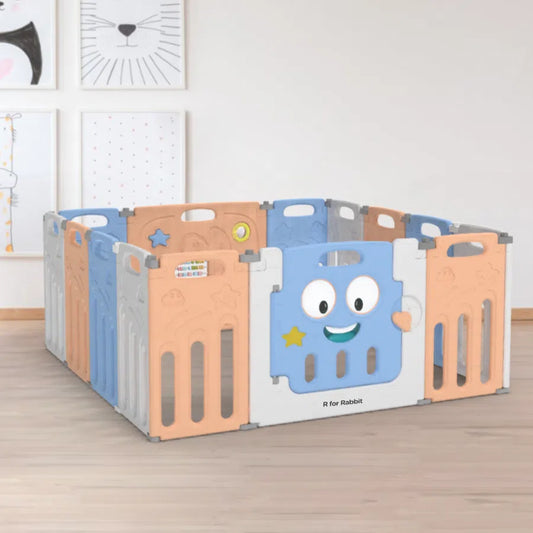
Indian parents mostly look for a good mid-range playard that will earn back its cost within the first few months. This is because you are getting hours of hands-free time back each day to do something productive. R for Rabbit’s Joyland Playard is something you must check if you are looking for a sturdy, well-designed, and high-quality option that covers all the basics.
RELATED PRODUCTS
- ₹ 9,498
- ₹ 13,995
- 32% off

- ₹ 9,498
- ₹ 13,995
- 32% off

- ₹ 1,848
- ₹ 2,691
- 31% off

 Bestseller

- ₹ 2,443
- ₹ 3,393
- 28% off


