


Infant Car Seat vs Convertible Car Seat: How to Choose and What Actually Works for You

The first drive home from the hospital is short but it stays with you. Before that day even arrives, the question comes up, usually while scrolling at midnight or getting advice from relatives: do you start with a small infant seat or go straight to a convertible?
Both sides have loud advocates. Neither group is entirely wrong.
Here is what the two types actually are, how they differ in daily use, and what to weigh before you buy.
What are Infant Car Seats and Convertible Car Seats?
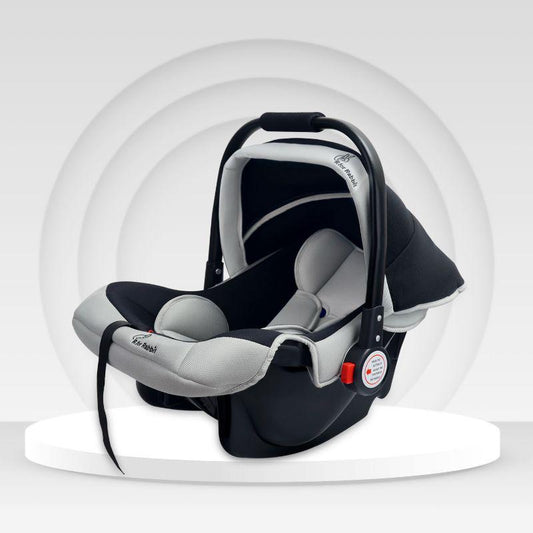
An infant car seat is built for newborns and younger babies. It always faces the back of the car, which is the safest position for a small neck and spine. Most models have two parts: a base that stays fixed in your car, and a lightweight seat that clips in and out. You carry the whole seat by a handle, baby and all, from car to clinic to stroller frame.
A convertible car seat is a single unit that stays in the car. It starts rear facing for a newborn and can later be turned forward facing as your child grows into the toddler and preschool years. Seats like the R for Rabbit Jack N Jill Grand support children from birth up to 25 kg, which covers several years of regular use without needing a replacement.
Which is safer? Infant Car Seat or Convertible Car Seat?
Both are safe when used within their height and weight limits and installed correctly. The bigger variable is how long your child stays rear facing, not which type of seat you buy.
A rear-facing seat spreads the force of a crash across the back, head, and neck, so the seat absorbs most of the impact rather than your child's body. Many convertible seats allow rear-facing up to 18 kg, which means a heavier toddler still gets that protection.
As the American Academy of Pediatrics states, children should stay in a rear-facing seat for as long as the seat's limits allow. In India, look for seats marked ECE R44/04 or i-Size. A mid-range seat that fits your child and car well, installed correctly, will protect better than an expensive seat that wobbles.
The Differences That Actually Matter Day To Day
|
Feature |
Infant car seat |
Convertible car seat |
|
Age range |
Birth to about 9–15 months |
Birth to about 4–7 years |
|
Orientation |
Rear facing only |
Rear facing, then forward facing |
|
Portability |
Carry it by the handle |
Fixed in the car |
|
Fit for newborns |
Snug, shaped for small bodies |
Bigger shell; works, but can feel roomy |
|
Stroller use |
Clicks onto matching frames |
Not compatible |
|
Cost over time |
Lower upfront, second seat needed later |
Higher upfront, no second seat for years |
The portability gap is where parents feel it most in the early weeks. You park, press a button, lift the seat, and your sleeping baby stays asleep while you walk into a clinic or a relative's home. With a convertible seat, you unbuckle and carry your baby in your arms every time. That trade-off is real when babies nap constantly and at unpredictable hours.
Fit for newborns is worth checking in person. Infant seats are shaped like a small nest with soft inserts for the head and sides. Convertible seats are bigger inside, and while most newborns sit well in them, very small or early babies may need extra attention to harness height and head support.
On cost: the infant seat usually costs less at purchase, but nearly every family needs a second seat within a year. A good convertible seat costs more once and then works for multiple stages. Neither is objectively smarter. It depends on how much weight you give to the first-year convenience versus the longer-term spend.
How To Decide For Your Family?
An Infant Seat Tends To Work Well If:
You take a lot of short trips, clinic visits, store runs, visits to relatives. Lifting a sleeping baby without unbuckling is genuinely useful in those early weeks. It also makes sense if you travel in different cars, cabs, or on trips, since you can carry the seat with you.
You want a travel system where the car seat clicks onto a stroller frame. In city life, this is worth more than it sounds. You move from car to footpath to mall to auto without disturbing the baby or dealing with a bulky stroller.
A Convertible Seat Tends To Work Well If:
You prefer learning one seat and using it for years. Your child grows with it through newborn, infant, and toddler stages without any transition. Some families find there is real comfort in that continuity.
You mostly drive longer distances rather than short hops. If most of your journeys are highway trips, family outings, or weekend travel, the daily portability trade-off matters less. Rear-facing time and comfort over longer stretches become the priority.
Before buying either, check your car. Rear-facing convertible seats take up real space, and the front seat sometimes needs to slide forward to accommodate them. If you or your partner are tall, this is worth testing in person before you commit. Also check whether your car has ISOFIX anchor points near the back seats. Seats that clip into these metal points are easier to install correctly and harder to get wrong.
If you go with a convertible from day one, test how your newborn fits, confirm the harness can sit at or below the shoulders, and make sure the head does not slump forward during the ride.
Using both Infant Car Seat and Convertible Car Seat
Some families start with an infant seat for the first year, then move to a convertible when naps get less frequent and carrying a separate seat every trip feels less necessary. This costs more in total but gives you the best of both phases.
If that is the plan, it helps to pick an infant seat that works as part of a travel system. R for Rabbit's Pocket Stroller Lite paired with a compatible infant seat, for example, gives you a compact setup that works well in city spaces. When the child moves on to a convertible like the Jack N Jill, the stroller continues as a standalone. That way the infant seat phase pays for itself through genuine daily use before you retire it.
6 Safety Features Worth Checking Before You Buy
- Five-point harness: Look for straps at both shoulders, both hips, and between the legs. In rear-facing mode, the straps should sit at or just below the shoulders. Snug them at every trip.
- Installation: After fitting, tug the seat firmly at the belt path. It should not move more than about an inch in any direction. ISOFIX seats clip directly into the car's anchor points and are generally easier to get right. If using a seat belt, press down on the seat while tightening.
- Safety marks: ECE R44/04 covers front and rear impact testing. i-Size adds side impact testing. Both are worth looking for on the label.
- Recline: Newborns should never sit upright in a car. Their heads are heavy relative to their neck strength, and a head that tips forward can press on the airway. Choose a seat with a deep recline option for newborns and a more upright position for older babies.
- Side protection: Check the side wings around the head. Deep foam-padded sides absorb energy in a side impact. Adjust the headrest so it sits just above the shoulders.
- No aftermarket add-ons: Thick cushions, separate head supports, and harness covers that did not come with the seat can interfere with how it performs in a crash. Stick to what the manufacturer supplies.
7 Common Mistakes to Avoid Before Buying
- Buying without checking your car first. Many convertible seats are larger in rear-facing mode than they look in photos. Test the fit, or at least check the seat's dimensions against your back seat length, before paying.
- Turning forward facing too soon. Bent legs and feet touching the back seat look uncomfortable but are not unsafe. Keep your child rear facing until they reach the seat's height or weight limit for that mode.
- Loose installation. After fitting the seat, it should barely move at the belt path. If it shifts more than an inch, remove it and refit. Having a second person press down while you pull the belt helps.
- Using an old seat. Plastic ages, especially after repeated exposure to heat inside a parked car in Indian summers. Check the manufacture date and the manufacturer's stated lifespan. Be cautious with any seat that has been in a crash, even a minor one.
- Buying by price or looks. The most expensive seat is not always the safest for your specific car and child. Fit and correct installation matter more than price bracket.
- Skipping the manual. Every seat model has its own belt routing, harness height rules, and recline settings. Read the manual alongside your car's manual the first time you install. Keep it in the glove box for reference.
- Thick clothing under the harness. Puffy jackets compress in a crash, creating slack in the harness at the moment it matters most. Remove bulky outer layers before buckling, then cover your child with a blanket over the straps if needed for warmth.
R for Rabbit’s Car Seat Guide
- Common Mistakes Parents Make with Baby Car Seats
- How to Choose the Best Baby Car Seat?
- 5 Best Baby Car Seats in India Tested by Experts
- When to Switch from Infant Car Seat to Booster Seat?
- How to Keep Your Baby Safe Using an Infant Car Seat?
Choosing What Fits Your Life
There is no universally right answer here. Families with frequent short trips and city routines often find the infant seat earns its cost in the first year. Families who drive longer distances and prefer buying once find convertible seats simpler over time. Some do both.
Whatever you choose, fit and installation matter more than brand or price. R for Rabbit makes both infant carry cots and convertible seats built for Indian road conditions. The Jack N Jill convertible range and the Pocket Stroller Lite travel system are worth looking at when you are ready to buy.
R for Rabbit’s Car Seats to Buy
 Bestseller

- ₹ 5,898
- ₹ 7,992
- 26% off
Bestseller

- ₹ 6,928
- ₹ 8,991
- 23% off
Bestseller

- ₹ 11,877
- ₹ 16,497
- 28% off
 Bestseller


- ₹ 5,938
- ₹ 8,595
- 31% off
Bestseller

- ₹ 3,958
- ₹ 5,499
- 28% off
Bestseller

- ₹ 4,552
- ₹ 5,895
- 23% off


